ConQuest – India’s Premier National Quiz on Indian Constitution, History, and Politics

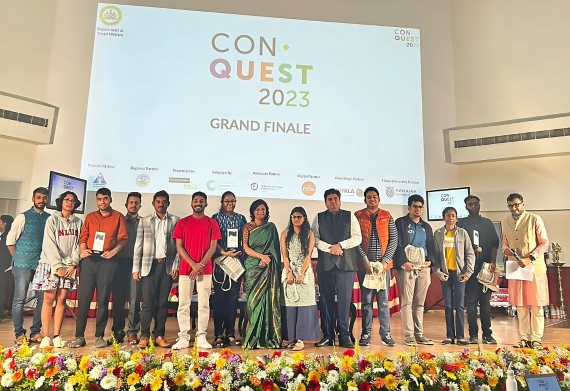
ConQuest is an annual flagship quiz organised by the Constitution Culture team at Centre for Law and Policy Research. It serves as the public outreach arm of CLPR’s Constitutionofindia.net initiative. Since its launch in 2016, ConQuest has grown to become India’s largest quiz celebrating the Indian Constitution, History, and Politics.

ConQuest strives to foster a vibrant constitutional culture with the help of digital public goods and building civic education initiatives. Currently in its 8th edition (2024), ConQuest encourages undergraduate and graduate students from all disciplines, including natural sciences, social sciences, engineering, humanities, and law to engage with the Indian Constitution, law, politics, history, and current affairs.

In late October/November each year, the ConQuest team crisscrosses across India to conduct four regional rounds (East, West, North, and South) culminating in a national final. Each regional round consists of a preliminary and a regional final rounds held on the same day. The top two teams from each regional final compete at the national final.

Questions are drawn from ConstitutionofIndia.net – the world’s most accessed digital archive of Indian constitutional and political materials, along with commentary and analysis on contemporary affairs.

We have engaged with over 10000 students during our 7-season run and counting. CLPR strives to foster inclusivity in academic spaces. Therefore, while more than one team can participate from a single college, since 2019, we have made it mandatory that each team of three must have at least one non-male member.

CLPR believes that the Constitution must transcend boundaries and become a part of the common persons’ vocabulary and life. Therefore, through this public outreach programme, our goal is not only to increase student participation as competitors but also increase participation as audience members, fostering a broader constitutional conversation that involves as many people as possible. Therefore, we encourage students and faculty to observe the quiz as audience members who often enthusiastically answer questions that no team was able to resolve.


Pluralist Agreement and Constitutional Transformation (PACT)

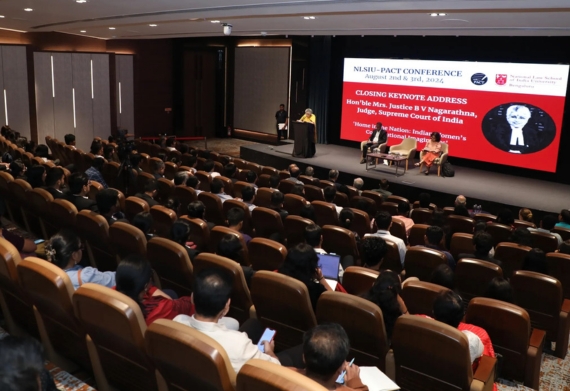
Since October 2022, the Centre for Law and Policy Research (CLPR) is participating in a three-year long research project titled ‘Pluralist Agreement and Constitutional Transformation’ (PACT).

The project is led by Prof. Rochana Bajpai, SOAS as principal investigator with Vineeth Krishna, CLPR sering as a co-investigator. Other co-investigators are Dr. Nicholas Cole, University of Oxford, Dr. Udit Bhatia, University of York, and Dr. Prof. Sudhir Krishnaswamy, National Law School of India University.

The PACT project will create an advanced digital platform on the making of the Indian constitution (1950). The Indian Constituent Assembly (1946-49) met against the background of transfer of power from the British, partition, Hindu-Muslim blood-shed, and the largest mass migration in history. It is during these challenges and disagreements along the lines of religion, caste and linguistic differences that the constitution was drafted, a document that continues to shape contemporary politics.

This research will aim to draw lessons regarding the democratic legitimacy of constitutions from the Indian example, while analysing its unfulfilled potential for pluralism and democracy in the present. The research also aims to shed light on the role of collective practices of petition, debate, and protest by citizens and the marginalized in the making of constitutions, and their remaking over time.

Using the methodologies and software developed at Pembroke College by the Quill Project, the project will create an extensive digital record of the proceedings from 1946 to 1949 that led to the formation of the Indian constitution. Alongside these plenary debates of the Indian Constituent Assembly, the project will also include committee discussions, petitions, public responses and the wider debate of the period. This broad collection of sources will allow further study into the context of public opinion against which the Indian constitution was authored.

The Constitution Defenders Project

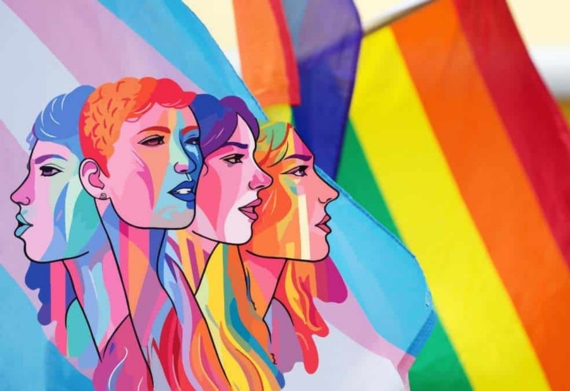
This project targets transgender persons, women and girls, SC & ST communities, gender and sexual minorities, and persons with disabilities, and, all of whom have historically faced social exclusion, discrimination, and lack of access to education, healthcare, and employment.

Recognizing this, the State has enacted laws such as the Transgender Persons (Protection of Rights) Act, 2019, Scheduled Caste and Scheduled Tribe (Prevention of Atrocities) Act, 1989, and Persons with Disabilities Act, 2016. However, many individuals remain unaware of their rights and face barriers in accessing legal services, including lack of resources, awareness of legal aid, and affordable legal representation.

The Constitution Defenders Project aims to enhance access to justice for these vulnerable groups in across India through:

  • Constitution Defender Fellowship: Young lawyers will undertake a 2.75-year fellowship to provide legal representation, and offer specialized legal assistance.

CLPR will mentor, support, and build the capacities of this cadre of Constitutional Defender Fellows in a sustained manner to ensure that vulnerable groups have access to high-quality and effective legal services, thereby significantly improving their access to justice.
Strengthening Transgender Rights in India

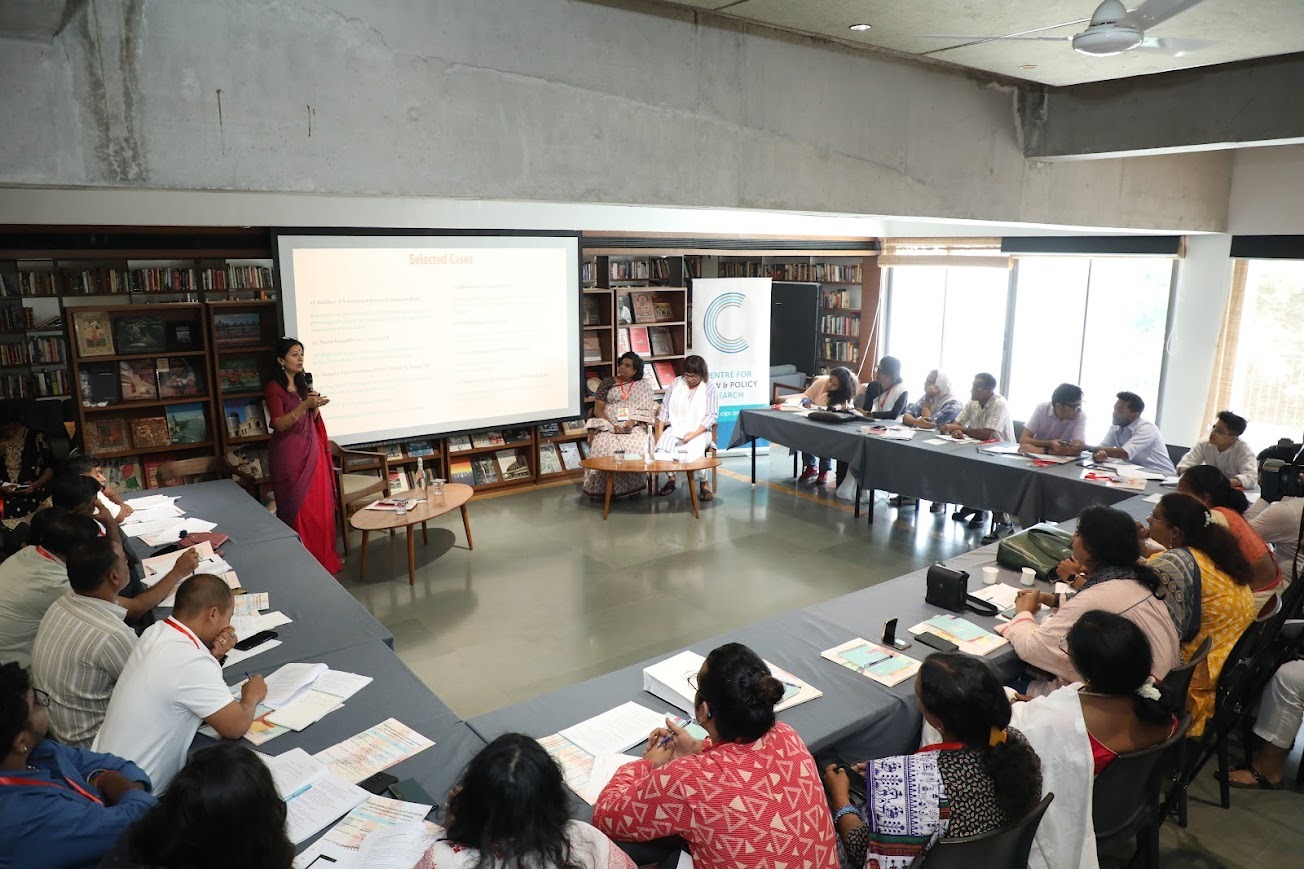
CLPR concentrates on strengthening its work on transgender rights and contribute to the development of trans equality in India through three initiatives namely the Trans Law Cell, the Global Trans Law Database, and Know Your Rights and Entitlement Session (KYRE) and Roundtable Conference on Transgender Issues.

The South Asian Translaw Database supports law and policy engagement efforts by the transgender community, legal professionals, government officials and academics from the South Asian region and beyond. The Database includes, primary legislation & rules from international, national and provincial levels, policy documents created by governments and civil society, and court cases including court documents and decisions relevant to the rights of transgender, non-binary and intersex persons.

The Trans Law Cell is an initiative by CLPR that provides free legal aid and advice to the transgender community, and empowers members of the trans-community to better understand, and fight for, their rights. It is a free walk-in legal clinic which takes place every week on Tuesdays, between 5-6 PM. Besides matters of legal documentation, the Trans Law Cell is open to providing all and any kind of legal aid to transgender persons. The Cell has also provides legal advice to persons who wish to establish inclusive societies within corporate firms, to ensure that there is no discrimination based on gender and gender identity in corporate environments. The Trans Law Cell does not require prior registration or appointments.