
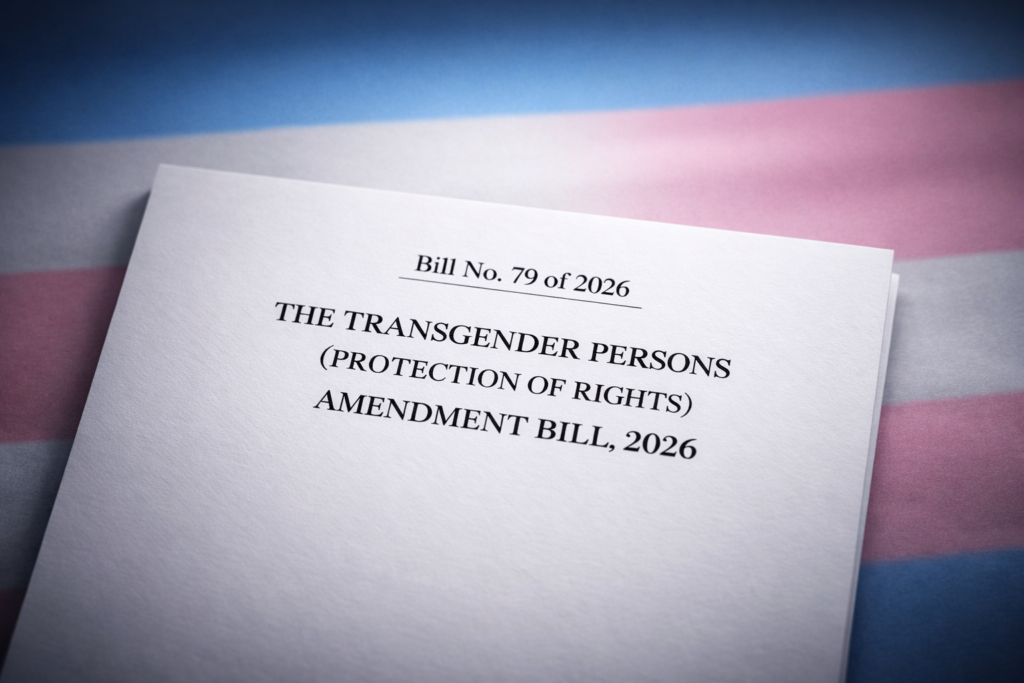
The new amendment that was introduced in the Lok Sabha on 13 March 2026 brings the rights of the trans community, particularly trans masculine and gender non-binary persons into jeopardy. The Transgender Persons (Protection of Rights) Amendment Bill 2026 (‘the Bill’) seeks to amend the earlier 2019 Act to narrow the definition of a transgender person, further medicalise the process for legal documentation and introduces new crimes. In this blog, we address how these impact the rights of all trans people.
The right to self-determination taken away
The right to self-determine one’s gender identity was upheld in NALSA v Union of India in 2014 to recognise that anyone can assert their gender as male, female or transgender, as they experience it psychologically or socially, even without medical gender affirmative surgery. This right is located in the right to equality, right to expression and the right to life with dignity under Articles 14, 19 and 21 of the Constitution. Since 2014, it has become an entrenched part of Indian constitutional law, upheld by 2 Constitution Benches (Navtej and Supriyo) and several High Court cases. However, this Bill seeks to take away this right and explicitly proposes removing section 4(1) of the 2019 Act which provides the right to ‘self-perceived gender identity’.
Exclusionary Definition
Further, the Bill restricts the definition of transgender from an inclusive one (‘a person whose gender does not match with the gender assigned to that person at birth’) to just three categories: (i) socio-cultural identities (such as hijra, kinner, aravani, jogta and ‘eunuch’) (ii) persons with 5 specific intersex variations and (iii) those who were ‘compelled’ to present as transgender.
Such a definition excludes several identities that are not traditionally seen as socio-cultural, including all trans masculine and non-binary identities, and trans women who do not belong to those specific communities. It is even unclear if other socio-cultural identities such as kothis, nupi maanbi, thirunangai will be recognised.
The Statement of Objects and Reasons provides vague reasons for this exclusion such as complexities in enacting statutes and in providing benefits under the Act, without any data to support this claim. Such an exclusion creates a hierarchy within trans communities with no intelligible differentia, resulting in a violation of Article 14 of the Constitution.
Medicalisation of the Certification Process
The Bill furthers the medical or biological model of gender that NALSA had overruled. The 2019 Act and Rules allows a person to identify as ‘transgender’ under section 6 through an affidavit submitted to the District Magistrate. After this certificate is received, they may apply to identify as ‘male’ or ‘female’ under section 7 with proof of ‘medical intervention’.
The Bill now requires the District Magistrate to take the recommendation of a ‘medical board’ and ‘any other medical experts’, the latter of which is undefined. The Bill also requires that any medical institution where one undergoes surgery to change gender must report it to the District Magistrate for a section 7 certificate.
These new provisions further undermine the right to self-determination but also constitute a gross breach of the right to privacy upheld in Puttaswamy v Union of India. With regards to the medical board, there is no clarity on the scope and procedure it will follow, which could result in invasive examinations and opportunities for harassment.
Criminalisation of Alleged Forced Labour and Trafficking
Under section 18 of the current Act, harm or injury to a transgender person is met with a punishment of six months to 2 years, which is a much lower sentence than for women under the BNS. The Bill, instead of correcting this inequality, introduces 2 new crimes.
First, it introduces the offence of kidnapping and causing grievous hurt by emasculation, hormonal procedure, etc. or severe injury to the body or bodily functions, punishable with 10 years to life. Second, the use of force, or undue influence, to compel someone to present as transgender and employing them in begging, solicitation or forced labour, punishable with 5 to 10 years. If the victim is a child, then the penalties imposed will be imprisonment for life or 10 to 14 years respectively. The language echoes the Criminal Tribes Act 1871, a colonial law which sought to ‘eradicate’ gender non-conforming people and was one of the first to be repealed after independence by the Constituent Assembly.
In Vyjayanti Vasanta Mogli v State of Telangana, the Telangana High Court held that similar provisions of criminalisation had a chilling effect on the freedom of expression and the right to privacy, and furthered derogatory stereotypes of the transgender community. This Bill could criminalise trans kinship networks, supportive parents, medical workers providing gender-affirming care or social organisations and workers who support transgender persons.
Based on CLPR’s work in the field, the proposed amendment poses a grave threat to the rights of not just all transgender and queer people, but all people who seek to determine the path of their own lives, and should be withdrawn.