
Introduction
Many factors contribute to the glaring gender gap in the Indian higher judiciary, including an opaque, informal-networks driven appointments process, gender bias, and inflexibility of the profession with respect to the disproportionate familial responsibilities often imposed on women. While these have been studied to varying extents, internationally and in India, a lesser-studied barrier faced by women in the legal profession that prevents them from growing into leadership is that of sexual harassment at the workplace.
A 2019 study by the International Bar Association found sexual harassment to be ‘alarmingly commonplace in the legal profession’, with 36.6% of female respondents experiencing it. A recent study titled the ‘National Survey Documenting Voices of Women Legal Professionals in India’ conducted by the Supreme Court Bar Association (SCBA) noted that 16% women lawyers have faced workplace sexual harassment in a professional setting, and 57% faced backlash for reporting or seeking remedies against this.
CLPR’s Survey
To examine the issue of sexual harassment faced by women lawyers in more depth, CLPR formulated an online survey to collect insights – both quantitative and qualitative – into the prevalence of sexual harassment faced by women lawyers while practising in the Supreme Court and High Courts in the country. While the survey continues to be circulated publicly, it has received a total of 419 responses from women lawyers as on date.
Prevalence and Nature of Sexual Harassment
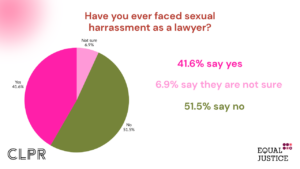
The initial findings from the CLPR Survey are concerning. As many as 41% (172) respondents have mentioned facing sexual harassment in their career, and 32.7% (137) have witnessed it. Additionally, 68.9% (288) respondents have mentioned hearing their male colleagues talk about a woman lawyer or women generally in a sexually coloured manner. The most common type of sexual harassment stated to have been experienced so far is being looked at in a manner that made the respondent uncomfortable, reported by 144 respondents. This is followed by unwelcome physical contact such as patting, pinching, brushing against the body, and touching (113 respondents) and receiving sexual or sexually suggestive remarks (83 respondents). Notably, as many as 12 respondents have mentioned having faced sexual assault and/or rape.
Action Taken
A measurably higher proportion of respondents (40.3%) said that they did not take any action on the sexual harassment they faced or witnessed than those who did (22.2%). Among the small number of respondents (93) who did take some sort of action, most only confronted the perpetrator and told them not to do the acts again (68 respondents, or 73% of those who took action). Only 7% of the respondents who faced harassment filed complaints with Internal Committees either in the High Courts or Bar Councils. However, 46.1% of those who took action stated it led to no favourable outcome, and 46% faced retaliatory backlash, and the fear of damage to one’s professional reputation has emerged as the most common reason (mentioned by 82 respondents) for their failing to take any form of action on sexual harassment.
Availability of Complaint Mechanisms
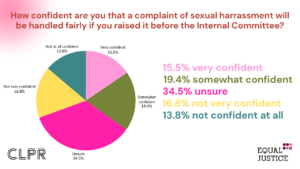
The small number of respondents who mentioned approaching Internal Committees under the Sexual Harassment of Women at Workplace (Prevention, Prohibition and Redressal) Act, 2013 have described unsatisfactory outcomes. 15 respondents mentioned that their inquiries were not in fact completed within the 90-day period prescribed under the Act, and only 8 stated that it was. Only 15.9% (36 respondents) have expressed significant confidence in Internal Committees. What is even more concerning is that 45.3% (191 respondents) have mentioned being unaware of where to report sexual harassment in their High Court in the first place.
Conclusion
Three broad conclusions emerge clearly from this preliminary analysis of the Survey’s findings. First, sexual harassment is extremely widespread in the legal profession, even at its higher levels. Secondly, women lawyers are extremely hesitant to report it, and even when they do, they typically resort to informal actions like confronting the perpetrator directly rather than using formal mechanisms like filing complaints with Internal Committees. Thirdly, there is a stark gap in both awareness of, and faith in, formal complaint mechanisms among women lawyers. The findings show that there is a serious need to create awareness on sexual harassment faced by women lawyers, whether grievance redressal mechanisms are indeed working, and how to make them more effective, so that we can address and curb the prevalence of sexual harassment to ensure that women lawyers have a safe working environment where they can practice freely and without fear.
If you are a woman lawyer practising in the Supreme Court or any High Court in India, we would be grateful for your insights on the issue through this Survey. It is fully anonymous and will not take more than 10 minutes to complete. Please fill the survey here.