

Introduction
The higher judiciary in India has a women’s representation problem. As of 1 June 2026, only 14.6% of the judges in the High Courts (“HCs”) were women. The argument for equal representation of women in the higher judiciary, is made so that the judiciary reflect the society and be representative of the gender and caste diversity in our country today. While there is a stated rule that judges to the High Courts would be appointed from the Bar and the Bench in a 2:1 ratio, there is a drastic shortage of women judges in the High Courts from the Bar. When this issue is raised, the response usually given is that there are not enough women lawyers practicing in the High Courts and the Supreme Court.
Our data shows that this claim is not true. While the exact number of male and female advocates and also gender minorities lawyers practising in any court is difficult to determine, one method to get a reasonably accurate number is from the membership of a Bar Association. Bar Associations are voluntary associations of advocates which represent the advocates’ collective interests and look at the welfare of the advocate-members. Since membership of such a bar association is a precondition to accessing the facilities at the court premises, it would provide reasonable information on the number of advocates practicing regularly before the said High Court and how many are women.
Methodology
We began this exercise by trying to get gender disaggregated data of the High Court Bar Associations and the Supreme Court Bar Association (SCBA) to see the percentage of women lawyers practising. One of the biggest challenges in getting this data was that none of the Bar Associations maintain gender disaggregated data of its members. Surprisingly none of the Bar Associations maintain such information, including the SCBA.
Therefore we obtained the directories and / or voter registration lists of the Bar Associations of the SCBA and five High Courts, of Himachal Pradesh, Gujarat, Orissa, Kerala, and Delhi. All of the data on members had to be scraped manually from the directories of the Bar Associations of these Courts. We also had to gender disaggregate the data manually. To sort the entries by gender, we referred to honorifics used in the title (Mr./Ms./Mrs./Sri/Smt.) or pictures on the directory, if available. Where neither was available, we defaulted to local naming conventions to estimate the gender of the members, and obtained the gender composition. This does not take into account the presence of gender minority advocates as this information was not available.
Findings
Based on our analysis, the gender split in the following Bar Associations is as follows:
- Delhi High Court Bar Association: Out of a total of 36,419 registered members as of 2025, there are 23.3% or 8472 women advocates.
- Kerala High Court Advocates Association: Out of a total of 10,059 registered advocates, there are 30.5% or 3067 women advocates.
- The High Court Bar Association, Orissa: Out of a total of 5600 registered advocates, there are 28.3% or 1584 women advocates.
- Himachal Pradesh High Court Bar Association: Out of a total of 1006 registered advocates, there are 28.3% or 1007 women advocates.
- Gujarat High Court Advocates Association: Out of a total of 4298 registered advocates, there are 23.4% or 241 women advocates.
- Supreme Court Bar Association: Out of a total of 3392 registered advocates in the voter list of SCBA of 2026, there are 17.72 % or 601 women advocates.
The average percentage of women advocates in the 5 High Court Bar Associations is 25.89% which is a substantial percentage, close to almost 30%. In the SCBA the percentage of women advocates is lower being 17.72%, which is understandable as this is the Supreme Court.
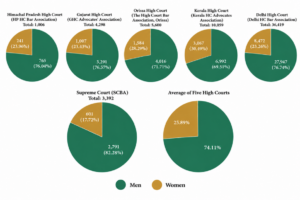
Figure 1: Gender composition of 5 High Court and the Supreme Court Bar Associations.
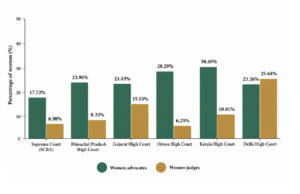
Figure 2: Representation of women in the Bar against their representation in the Bench
From the numbers and the figures, we can thus observe that the representation of women in the Bar is much lower than their representation on the Bench. On average, 25.88% of the Bar of the five High Courts consists of women, but the representation of women on the bench in these courts is much lower. This representation gap is especially stark in case of the Orissa and Kerala High Courts where women are highly underrepresented despite having substantial percentage of women lawyers practising. The Delhi High Courts is the only court studied which had a near proportional representation. In case of all the High Courts, the proportion of women lawyers practising, as per bar associations data is much higher, hinting at serious under-representation of women in the judiciary.
Conclusion
We will be following this piece with findings on the data in the remaining High Courts. However, what is quite clear is that it is important for all Bar Associations to collect and publish gender disaggregated data of their membership, which will enable not only to understand the percentage of women lawyers but also the percentage of lawyers from gender minorities. If we are committed to ensuring equal participation of women in the legal profession, collection of such data and making it available is paramount. Data on numbers and percentage of women advocates would enable the Bar Associations to work towards reforms and facilities for women members of the Bar.
Such data would also enable government and other legal institutions to use the data for policy reform. In the present case, the data shows importantly that there is a serious mismatch in the percentage of practising women members in the Bar and the representation of women in the higher judiciary which should be brought to a minimum of 30% women judges in all High Courts. Serious efforts will be need to be taken to bridge this gap.
Written by Jayna Kothari, Abhineet Maurya & Tulsi Nambiar.