
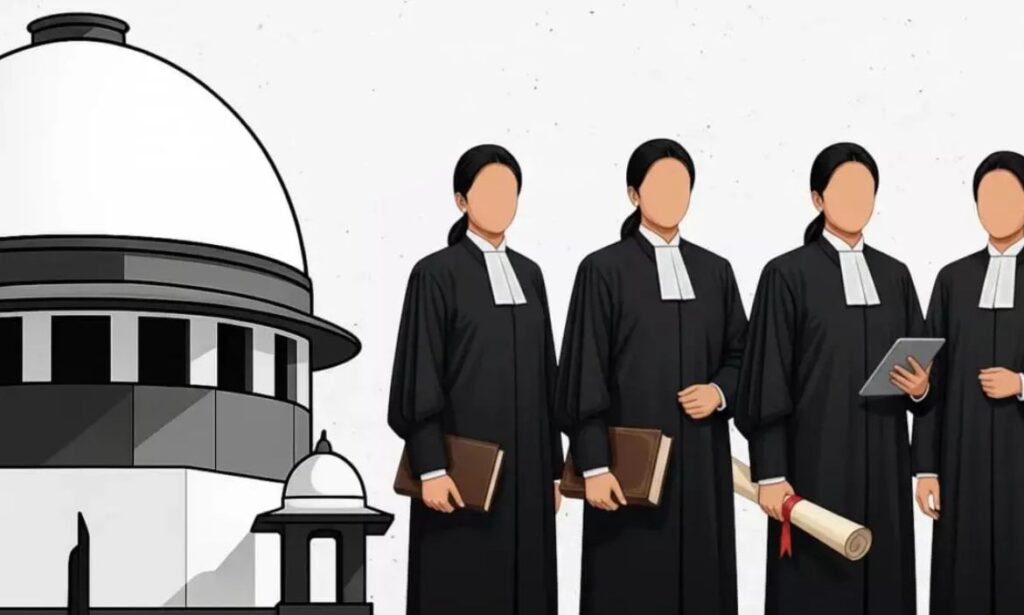
On 24th March 2025, in the cases of Deeksha N. Amrutesh v. State of Karnataka and Ors, Karnataka Federation of Women Lawyers v. State of Karnataka, and Kavitha H.C. v. State of Karnataka, the Supreme Court ordered all of Karnataka’s district bar associations to reserve 30% of office-bearer/executive posts for women and earmark the Treasurer’s post for a woman. Ten months later, on January 16 of this year, the Court turned to the question of compliance.
Responding to an affidavit filed by the Karnataka Federation of Women Lawyers (KFWL), the Supreme Court has now directed the Registrar General of the High Court of Karnataka (and other High Court Registrars General) to compile and submit accurate compliance data for every bar association within its jurisdiction. With women systematically underrepresented in the legal profession and in bar associations nationwide, the Court’s recent order is a meaningful step toward translating formal equality into institutional change.
As discussed in a Center for Law and Policy Research (CLPR) blog post last year, the Petitioners—KFWL and two women advocates—secured their first victory when the Supreme Court invoked its powers under Article 142 of the Constitution and directed the Advocates’ Association, Bengaluru (AAB) to enact the 30% and Treasurer post-related reservations. In a second order on March 24, 2025, the Court then notably stated that its directive to the AAB shall apply mutatis mutandis in elections of bar associations across the entire state of Karnataka and entrusted the Karnataka High Court with the responsibility of submitting a comprehensive compliance report to the Supreme Court.
The Karnataka High Court did indeed submit its compliance report in an affidavit in September 2025. This Report was replete with vague assertions of compliance and statements of intent rather than verified data, and it spurred KFWL to examine whether or not women have actually been able to assume their reserved bar association positions in the 150+ bar associations across Karnataka. As reflected in the KFWL’s reply affidavit submitted in early January, publicly available election records and communications with bar association representatives unveiled numerous cases of non-compliance or only partial compliance. Of the 29 bar associations that KFWL was able to confirm had conducted elections since the March 2025 order, only four had complied with the directions of the Supreme Court. Fifteen bar associations had partially complied, and ten failed to comply at all.
The stakes of this litigation extend far beyond women gaining leadership seats at the table on paper. Bar associations are powerful institutions within the legal ecosystem, shaping access to professional networks, welfare measures, and engagement with the judiciary. Those in bar leadership positions influence whose voices are heard and whose are prioritized. When women lawyers are excluded, so too is progress on issues that disproportionately affect marginalized legal professionals—such as workplace harassment and unequal professional opportunities. Women’s representation in bar associations matters because, as with representation in the profession and public institutions more broadly, it can enhance decision-making quality; expose and address gender bias and structural barriers; promote more equitable career progression and leadership opportunities; and strengthen public trust in legal institutions.
Representation does not by itself guarantee substantive change, however, and the Supreme Court’s latest order is a reminder that transformative remedies require sustained scrutiny. As the Supreme Court obtains verified compliance data, the focus must remain on whether bar associations are genuinely opening up spaces of power to women or merely adjusting their leadership to withstand judicial review.
For women lawyers across Karnataka and the country, the fight for bar association representation is thus not merely about meeting numerical targets but about the right to participate fully—and to shape the governance of a profession that has long excluded them.
This blog is written by our research intern, Nikhita Salgame, 3rd Year law student at the Harvard Law School, Cambridge, Massachusetts, USA.